
Compacting & Dewatering
Wash Compactors
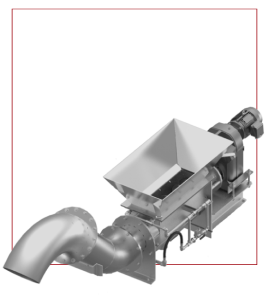
The Screw Compactor is used for effective de-watering, compaction and transportation of screenings into a waste bin. The structural and functional simplicity of the compactor’s design greatly reduces solids volume with minimum maintenance. Screw Compactors consist of a conveyor trough in stainless steel, a shaftless extra-heavy-duty spiral in carbon steel, a compacting and de-watering discharge module, a return duct for squeezed out water and a drive unit suitable for the application.
The screenings are conveyed within the wash compactor from the inlet zone to the compaction zone, the washing occurs while the screenings are conveyed with the screw and wash water is added and organic matter is washed out. The conveyor screw delivers the washed screenings to the pressing zone where the compacted screenings are discharged through a discharge chute into a bin on site. Up to 50% of dry screenings is removed with a high operating capacity.
Wash Compactors
The Screw Compactor is used for effective de-watering, compaction and transportation of screenings into a waste bin. The structural and functional simplicity of the compactor’s design greatly reduces solids volume with minimum maintenance. Screw Compactors consist of a conveyor trough in stainless steel, a shaftless extra-heavy-duty spiral in carbon steel, a compacting and de-watering discharge module, a return duct for squeezed out water and a drive unit suitable for the application.
The screenings are conveyed within the wash compactor from the inlet zone to the compaction zone, the washing occurs while the screenings are conveyed with the screw and wash water is added and organic matter is washed out. The conveyor screw delivers the washed screenings to the pressing zone where the compacted screenings are discharged through a discharge chute into a bin on site. Up to 50% of dry screenings is removed with a high operating capacity.
Sludge Dewatering
The Multi Plate Screw Press is developed to utilize the dewatering principles of force-water homo-direction, thin-layer dewatering, proper pressure and extension of the sludge dewatering path. The equipment is more advanced than the traditional dewatering equipment which are easily blocked, unsuitable for low-concentrated sludge and oily sludge, of high consumption and difficult to operate. Our Multi Plate Screw Press eliminate these problems, are of higher efficiency and less power consuming.
The Multi Plate Screw Press, which is controlled by the electric control cabinet, allows automatic continuous operation of sludge flocculation, thickening, dewatering and the filtrate discharging.
The conditioned sludge flows into the filter chamber from the flocculation tank and is pushed forward to the discharging end. With the gap between the thread of the shaft that is getting more and more narrow, the pressure on the sludge is getting higher and higher. The water is separated from the sludge and flows out from the gap
between the moving and the fixed rings. The movement of the moving rings and the fixed rings cleans the gap between them and prevent the machine from blockage. The filtered sludge cakes are pushed forward by the shaft and finally discharged from the end.
The thickening zone and the dewatering zone makes the machine applicable to both highly concentrated sludge and that with a high-water content. It’s able to directly treat sludge with a solid content from 5000mg/l to 50000mg/l.
The dewatering of the multi plate screw press relies on the inner pressure of the filter chamber and the rotating speed is as slow as 2-4 r/min. Therefore, its power consumption is as low as 0.01-0.1 kw/h/kg-DS, only an 1/8 of that of belt presses and 1/20 of that of centrifugal machines. In addition, of course, there is little noise. Eventually, the operating cost can be greatly reduced.
The multi plate screw press can directly treat the sludge from the aeration tank and the secondary sedimentation tank so that the sludge thickening tank is not needed any longer. Therefore, the capital construction cost can be greatly saved and the phosphorus releasing problem is well avoided.
Sludge Dewatering
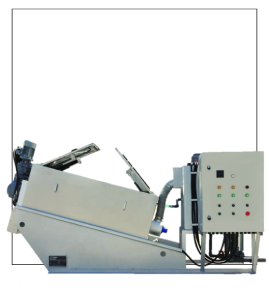
The Multi Plate Screw Press is developed to utilize the dewatering principles of force-water homo-direction, thin-layer dewatering, proper pressure and extension of the sludge dewatering path. The equipment is more advanced than the traditional dewatering equipment which are easily blocked, unsuitable for low-concentrated sludge and oily sludge, of high consumption and difficult to operate. Our Multi Plate Screw Press eliminate these problems, are of higher efficiency and less power consuming.
The Multi Plate Screw Press, which is controlled by the electric control cabinet, allows automatic continuous operation of sludge flocculation, thickening, dewatering and the filtrate discharging.
The conditioned sludge flows into the filter chamber from the flocculation tank and is pushed forward to the discharging end. With the gap between the thread of the shaft that is getting more and more narrow, the pressure on the sludge is getting higher and higher. The water is separated from the sludge and flows out from the gap
between the moving and the fixed rings. The movement of the moving rings and the fixed rings cleans the gap between them and prevent the machine from blockage. The filtered sludge cakes are pushed forward by the shaft and finally discharged from the end.
The thickening zone and the dewatering zone makes the machine applicable to both highly concentrated sludge and that with a high-water content. It’s able to directly treat sludge with a solid content from 5000mg/l to 50000mg/l.
The dewatering of the multi plate screw press relies on the inner pressure of the filter chamber and the rotating speed is as slow as 2-4 r/min. Therefore, its power consumption is as low as 0.01-0.1 kw/h/kg-DS, only an 1/8 of that of belt presses and 1/20 of that of centrifugal machines. In addition, of course, there is little noise. Eventually, the operating cost can be greatly reduced.
The multi plate screw press can directly treat the sludge from the aeration tank and the secondary sedimentation tank so that the sludge thickening tank is not needed any longer. Therefore, the capital construction cost can be greatly saved and the phosphorus releasing problem is well avoided.
